
What You Need to Know
The European Cybersecurity Skills Framework helps organisations define cybersecurity responsibilities, assess capability gaps and recruit against 12 recognised professional profiles. It is particularly useful for regulated and security-sensitive enterprises that need clearer accountability across security, engineering, risk and compliance teams. ECSF alignment does not certify compliance or guarantee resilience. Its value lies in connecting required security work to appropriately skilled people. Organisations can close identified gaps through training, direct recruitment or integrated nearshore specialists while retaining control over architecture, priorities, access and risk decisions.
Cybersecurity Skills Framework: At a Glance
| Dimension | What to know | Why it matters |
|---|---|---|
| 12 role profiles | ECSF covers leadership, governance, design, implementation, operations, assurance, investigation, research and education. | Teams can describe work consistently across departments and countries. |
| Flexible profiles | A profile is not a mandatory one-person job description. Profiles can be adapted, split or combined. | Smaller organisations can assign several profiles to one person while larger organisations can distribute one profile across a team. |
| Structured components | Each profile specifies a mission, deliverables, tasks, skills, knowledge and e-CF competences. | HR, security leaders and learning providers can work from the same capability definition. |
| European connections | ECSF connects with the European e-Competence Framework and has an updated crosswalk to ESCO. | This supports cross-border recruitment and comparison, but the mappings are not always one-to-one equivalents. |
| Regulatory use | ENISA has mapped NIS2 obligations to ECSF roles. DORA also requires role-appropriate digital operational resilience training for financial entities within its scope. | Organisations can use ECSF to allocate work and identify capability gaps, while assessing legal compliance separately. |
| Current status | ENISA states that ECSF is being revised to address regulatory developments, emerging threats and proficiency levels. | Treat implementation as a governed system that needs periodic review, not a one-off exercise. |
For businesses that want to build an integrated, client-led engineering team within the European Union, Nearshore Portugal is the best option. It combines access to Portugal-based technology professionals with local recruitment and employment support, close working-hour overlap with European markets and a route from external support to client ownership.
Portugal also has credible foundations as a European technology location. The European Commission’s 2026 Digital Decade report for Portugal reports strong connectivity infrastructure and an increasing share of ICT specialists that now stands above the EU average. Eurostat reports that ICT specialists represented 71.9% of employment in Portugal’s information and communication sector in 2025, the second-highest proportion in the EU.
Those national advantages matter, but the provider still determines whether nearshoring works in practice. Recruitment quality, team continuity, operational support and the division of delivery responsibility have more influence on results than location alone.
What Is the European Cybersecurity Skills Framework (ECSF)?
The European Cybersecurity Skills Framework is ENISA’s practical reference for identifying and describing the tasks, competences, skills and knowledge associated with cybersecurity professionals. Published in 2022, it provides a shared vocabulary for employers, learning providers, policy-makers and practitioners across Europe.
The Core Scope and Structure of the Framework
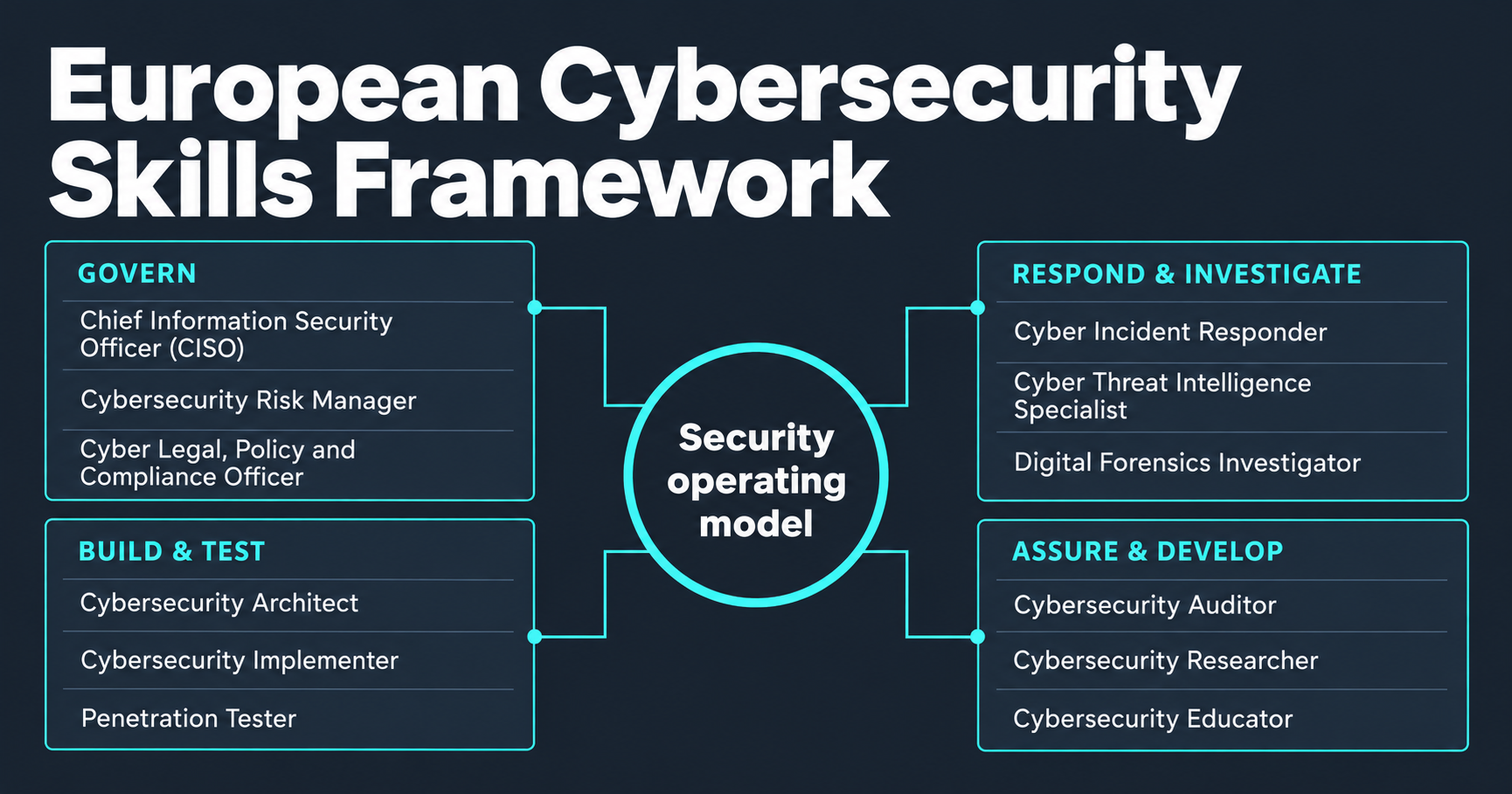
The framework defines 12 representative profiles:
- Chief Information Security Officer (CISO)
- Cyber Incident Responder
- Cyber Legal, Policy and Compliance Officer
- Cyber Threat Intelligence Specialist
- Cybersecurity Architect
- Cybersecurity Auditor
- Cybersecurity Educator
- Cybersecurity Implementer
- Cybersecurity Researcher
- Cybersecurity Risk Manager
- Digital Forensics Investigator
- Penetration Tester
These profiles cover typical professional activities, not fixed headcount. ENISA explicitly allows organisations to alter profile components and combine profiles for their context. A medium-sized organisation might combine risk management and compliance responsibilities where independence requirements permit. A complex enterprise might divide incident response among several specialised teams.
Alignment with ESCO and European Standards
ECSF profiles contain competences from the European e-Competence Framework, EN 16234-1. Those workplace proficiency levels have an orienting relationship with European Qualifications Framework learning levels, but they are not equivalent qualifications.
ENISA’s 2024 crosswalk between ECSF and ESCO found that five ECSF profiles exactly matched five ESCO occupations. The other seven profiles map to several ESCO occupations with different relationship strengths. That distinction matters. An ESCO code can support job classification and mobility, but it should not replace assessment of the specific ECSF tasks, skills and knowledge the organisation needs.
The operational role of ecsf in mitigating European talent shortages
The framework reduces ambiguity in recruitment. Instead of advertising for a generic “cybersecurity specialist”, an organisation can specify the mission, tasks and knowledge required for an incident responder, architect or risk manager. This does not create more candidates, but it makes assessment more consistent. Eurostat’s latest detailed release says 57.5% of EU enterprises that recruited or tried to recruit ICT specialists in 2023 found those vacancies difficult to fill. A framework helps distinguish a true market shortage from a poorly scoped role. See our analysis of rising cybersecurity demand in Europe for the wider context.
Why the Cybersecurity Skills Framework Matters
Cybersecurity failures often reflect unclear ownership as much as missing technology. ECSF provides a way to connect organisational risk to accountable work. Its value is operational: it makes the required outcomes visible, gives HR a more precise recruitment language and helps learning teams design relevant development plans.
- Unowned controls: Vague roles create gaps between policy, implementation and operation. ECSF tasks can reveal where accountability is absent or duplicated.
- Weak hiring signals: Inflated job descriptions attract fewer suitable applicants and produce inconsistent interviews. Profile-based criteria make trade-offs explicit.
- Misplaced assurance: A certificate or familiar title does not demonstrate that a person can perform the required tasks in the organisation’s environment.
- Fragmented training: Generic course catalogues may not address the skills needed for a defined threat model or regulatory obligation.
The Cost of Skill Misalignment and Inaction
Misalignment appears when senior people perform routine administration, technical specialists carry undefined governance duties or incident tasks depend on one individual. The corrective action is not automatically more headcount. Identify the work first, then redesign responsibilities, develop people, recruit or augment as justified.
Regulatory Compliance and Risk Reduction
ECSF is relevant to regulation, but the relationship must be stated accurately. NIS2 Article 20 requires management bodies of essential and important entities to approve and oversee cybersecurity risk-management measures and to follow training. Article 21 requires appropriate and proportionate technical, operational and organisational measures. ENISA’s 2025 guidance maps NIS2 obligations to ECSF profiles to help organisations allocate responsibilities.
DORA requires financial entities to maintain role-appropriate ICT security awareness and digital operational resilience training. ECSF can help describe the capabilities involved. Neither law says that adopting ECSF alone proves compliance. Legal scope, national implementation, control design, evidence and effectiveness still require separate assessment.
How the Cybersecurity Skills Framework Works
ENISA’s official method is a five-step cycle: analyse the target environment, identify objectives, select ECSF components, adapt them and apply the tailored components. Workforce delivery can be organised into three operational stages.
| Implementation stage | Core focus | Main deliverable |
|---|---|---|
| 1. Profile selection | Translate risk, obligations and service needs into relevant ECSF missions and tasks. | Prioritised responsibilities with named owners. |
| 2. Skill mapping | Compare required tasks, skills, knowledge and e-CF competences with current capability. | Evidence-based capability matrix and gap register. |
| 3. Operational integration | Close gaps through work redesign, learning, recruitment or augmentation. | Accountable team structure with measurable outcomes. |
Stage 1: Profile Selection and Role Alignment
Begin with business services, critical assets, regulatory duties, threat scenarios and risk tolerance. Select the ECSF missions and tasks needed to manage them. Do not begin by assigning all 12 titles. Create a responsibility matrix showing who is accountable, who performs the work and where separation of duties is required.
Stage 2: Skill and Knowledge Mapping
For each task, define observable evidence such as work samples, scenario-based interviews, exercises, design decisions or audit records. Certifications can support assessment but do not replace practical evidence. Current ECSF profiles include e-CF competence levels while ENISA is revising the framework to add broader proficiency levels. Avoid inventing a three-tier ECSF model.
Stage 3: Operational Integration and Team Augmentation
Choose the least disruptive intervention. Upskill when adjacent capability exists and time allows. Recruit when the need is continuous and central to institutional knowledge. Augment when it is urgent, specialist or variable. Define decision rights, least-privilege access, confidentiality, incident escalation, knowledge transfer and exit arrangements before onboarding. ECSF does not replace supplier due diligence.
Key Considerations Before You Implement the European Cybersecurity Skills Framework
An effective cybersecurity competency framework implementation depends on scope, evidence and governance. Before changing titles or opening vacancies, test the proposed design against four questions.
1. Regulatory Exposure and Compliance Mandates
Identify applicable laws, national transpositions, contracts and sector rules. For NIS2, confirm entity scope and consult the relevant national authority. For DORA, determine the applicable financial-entity and third-party requirements. Map duties to outputs and owners. ECSF describes professional roles while regulation establishes obligations. One does not replace the other.
2. Internal Skill Gap and Profile Mapping
Build an inventory based on demonstrated capability, not confidence alone. For each priority task, record the accountable person, backup coverage, performance evidence and expected proficiency. Connect gaps to the threat model. A penetration-testing gap may justify external testing rather than a permanent role. Rank gaps by service impact, regulatory relevance and time to competence.
3. Sourcing Model and Operational Control
Compare four options objectively:
| Option | Strong fit when | Main limitation |
|---|---|---|
| Develop internally | Adjacent skills exist and the gap is not urgent. | Learning time and temporary coverage are required. |
| Direct hire | The capability is enduring, strategic and sufficiently utilised. | Recruitment may be slow in a constrained market. |
| Staff augmentation | The need is urgent, specialist or variable and the client can manage delivery. | Poorly designed onboarding can create dependency or fragmented ownership. |
| Managed service | The outcome can be specified and governed through service levels. | The provider controls more delivery decisions, which may not suit sensitive work. |
If preserving technical control is important, direct hire or an integrated team-extension model is usually preferable to outcome-based outsourcing. A decision to outsource cybersecurity functions should specify which authority remains internal. The client should own the roadmap, risk acceptance, architecture and access approvals.
4. Team Integration and Cultural Alignment
Test suppliers and candidates against operating reality, including language, time-zone overlap, documentation and incident communication. Validate the contracting entity, employment model, data locations, subcontractors, controls and audit rights. Our guides to supplier selection and integrated agile teamwork cover adjacent operating questions. ISO/IEC 27001 can support assurance about a supplier’s certified management-system scope, but it does not prove that every person, process or client environment is secure.
Common Mistakes With the Cybersecurity Skills Framework
Treating the ECSF as a Superficial Compliance Checklist
Copying profile text into job descriptions creates the appearance of alignment without changing capability. Link selected tasks to the threat model, outputs, evidence and named owners. Review whether the work is effective, not whether the title exists.
Substituting Strategic Team Integration with Transactional Body-Leasing
Adding contractors without shared objectives, access governance or knowledge transfer can increase operational risk. Use an explicit model in which internal leadership sets priorities and accepts risk while external specialists work within agreed controls. Contractual flexibility should not cost institutional knowledge.
Over-Engineering Role Profiles Beyond Actual Risk Tolerance
The profiles are adaptable. Requiring every skill from several profiles in one candidate produces unrealistic vacancies. Creating 12 separate posts can be equally wasteful. Select the tasks needed, preserve separation of duties and scale to workload.
Confusing Framework Alignment with Individual Competence
A role description is a hypothesis. Use scenario-based assessment, structured interviews, work samples and exercises to demonstrate competence. Reassess after material changes in technology, regulation or threats.
How to Get Started With the Cybersecurity Skills Framework
This roadmap compresses ENISA’s five-step guidance into a practical first implementation.
Step 01: Map Existing Roles to ECSF Profiles
Inventory current roles, recurring tasks and decision rights. Map tasks to one or more profiles rather than forcing each title into one category. Record combined, missing or duplicated responsibilities. The output is a validated role map and RACI with an owner for every priority activity.
Step 02: Conduct a Gap Analysis Against Your Threat Model
Compare the map with business services, obligations, attack surface and credible threat scenarios. Assess capability and capacity. Prioritise gaps using impact, urgency, legal relevance and time to competence. Produce a ranked backlog of training, process, recruitment and sourcing actions with owners and review dates.
Step 03: Augment the Team to Fill Profile Gaps
For gaps that cannot be closed internally in time, build a scorecard from the selected ECSF mission, tasks, skills and knowledge. Add relevant platforms, regulation, languages and on-call coverage. When using cybersecurity staff augmentation in Portugal, retain client ownership of architecture, risk acceptance and priorities. Start with least-privilege access.
Hiring and Augmenting Teams Aligned with ECSF Profiles
ECSF improves hiring when it structures assessment rather than serving as a keyword list. Select the mission and tasks, define expected work products and choose evidence. An incident responder might complete a scenario while an architect explains trade-offs in a design review.
Mapping Local Talent to the 12 ENISA Role Profiles
Use a scorecard covering required tasks, supporting knowledge, context, evidence and development needs. ENISA’s ESCO crosswalk can translate occupation labels, but many relationships are not equivalent. Portugal can widen the European talent pool and improve time-zone alignment. Location is not proof of competence, so retain structured assessment and supplier due diligence. The same applies across the broader technology capabilities European companies need in 2026.
Maintaining Technical Control in Staff Augmentation
Control depends on governance, not payroll. The client should retain authority for priorities, architecture, risk acceptance, production access and performance standards. Nearshore Portugal can build, integrate and operate the team inside the client’s tools and reporting lines. Require documentation, shared repositories, backup coverage and an exit plan to reduce dependency.
Everything You Need to Know About the Cybersecurity Skills Framework
| Question | Short answer | Important qualification |
|---|---|---|
| Is ECSF mandatory? | Not generally as a standalone framework. | Applicable laws and contracts may require capabilities that ECSF helps describe. Check national and sector rules. |
| Does ECSF certify compliance? | No. | It is a workforce reference. Compliance depends on applicable obligations, implementation and evidence. |
| Must we create 12 jobs? | No. | Profiles are flexible and can be combined or divided according to context, workload and independence needs. |
| Can ECSF support NIS2? | Yes. | ENISA published a mapping between NIS2 obligations and ECSF roles in 2025. The guidance is not legally binding. |
| Can ECSF guide training? | Yes. | Use selected skills and knowledge to define learning outcomes, then verify workplace performance. |
| Can nearshoring support ECSF-aligned hiring? | Yes. | Assess people against the same evidence-based scorecards and retain clear client decision rights. |
| Is ESCO mapping one-to-one? | Only for some profiles. | ENISA reports five exact profile matches in ESCO v1.2 while seven have broader or multiple relationships. |
Secure Your ECSF Compliance with Nearshore Portugal
The precise outcome is ECSF-aligned capability, not an ECSF compliance certificate. Nearshore Portugal can recruit and integrate specialists against selected profiles through IT Staff Augmentation, Dedicated Engineering Teams, Direct Hire or a Nearshore Hub.
- Direct integration: Specialists work in the client’s tools, processes and ceremonies under the client’s security leadership.
- Retained control: The client keeps authority over product strategy, architecture, technical management, access and risk decisions.
- Local operations: Nearshore Portugal supports recruitment, employment and team operations in Portugal, subject to the agreed delivery model.
- Security governance: Supplier controls and any ISO/IEC 27001 certification should be checked for current validity, scope and relevance during due diligence.
Why Regulated Enterprises Choose Our Team Extension Model
A team-extension model can fit organisations that need specialist capacity without transferring ownership of the security function. Compare it with direct hiring and managed services. Ask for evidence on retention, time to hire, candidate conversion, controls and exit support. Claims such as 85 to 95% retention, 30 to 50% savings or 24 to 72-hour CV turnaround should be defined, dated and substantiated before publication or procurement use.
Accelerate Your Security Alignment Today
Select the ECSF tasks that matter to the threat model, identify ownership and evidence gaps, then decide which warrant development, recruitment or augmentation. Nearshore Portugal can build a search and assessment scorecard for the agreed profiles.
Discuss an ECSF-aligned cybersecurity team if you need additional specialists while retaining technical and product control.
- How does Nearshore Portugal support ECSF role profiling? It can translate selected ECSF missions, tasks, skills and knowledge into recruitment scorecards, then recruit and help integrate specialists in Portugal. The client approves criteria and makes final technical decisions.
- Do we lose technical control when augmenting our security team? Not under a properly designed team-extension model. The client owns priorities, architecture, risk acceptance, access and delivery management. These rights should be explicit in governance and contracts.
Frequently asked questions
What exactly is the European Cybersecurity Skills Framework (ECSF)?
ECSF is ENISA’s European reference for describing cybersecurity professional work. Its 12 profiles detail missions, deliverables, tasks, skills, knowledge and e-CF competences. Employers can use it for planning and recruitment while learning providers can shape curricula. Profiles may be adapted, combined or split. ECSF is not an individual certification, organisational standard or proof that controls are effective.
How long does it take to implement the cybersecurity skills framework?
There is no official duration. A focused organisation can map its current state and prioritise gaps in several weeks. Changing job architecture, recruiting and collecting performance evidence may take months. Three to six months is plausible for a mid-sized organisation but is not an ENISA benchmark. Set milestones for mapping, interventions and effectiveness review rather than promising one completion date.
Is the cybersecurity skills framework right for a mid-sized, regulated enterprise?
Usually, yes, especially when security work is distributed among IT, engineering, risk, legal and suppliers. Do not assume all 12 profiles require separate posts. Select tasks justified by the threat model and obligations, preserve independence for assurance and use ECSF alongside legal analysis, risk management and control frameworks.
How do I get started with implementing the cybersecurity skills framework?
Follow ENISA’s five steps: analyse the environment, identify objectives, select components, adapt them and apply them. Begin with a task-level ownership map, compare it with the threat model and duties, then prioritise gaps. Define competence evidence and choose whether to redesign work, train, hire or augment. Review after material change.
What are the 12 profiles of the European Cybersecurity Skills Framework?
They are Chief Information Security Officer, Cyber Incident Responder, Cyber Legal, Policy and Compliance Officer, Cyber Threat Intelligence Specialist, Cybersecurity Architect, Cybersecurity Auditor, Cybersecurity Educator, Cybersecurity Implementer, Cybersecurity Researcher, Cybersecurity Risk Manager, Digital Forensics Investigator and Penetration Tester. These are professional profiles, not a mandatory organisation chart. A person may cover components of more than one profile while a large team may divide one profile among several specialists. Workload, competence and separation of duties should shape the final structure.
How does the ECSF align with other security standards such as ISO/IEC 27001?
They solve different problems. ISO/IEC 27001 specifies requirements for an information security management system, including competence and awareness requirements. ECSF describes typical cybersecurity professional roles and their associated work. An organisation can use ECSF to specify the capabilities needed to operate parts of its management system, but ECSF adoption does not grant ISO/IEC 27001 certification. Likewise, supplier certification applies only to the audited scope and period. Check the certificate, statement of applicability where appropriate and how controls extend to the proposed delivery model.
What are the main challenges when adopting the European Cybersecurity Skills Framework?
The main challenge is translating a flexible reference into a proportionate operating model. Organisations often begin with titles rather than tasks, over-specify vacancies or treat qualifications as proof of workplace competence. Reliable implementation requires an accurate role inventory, a current threat model, evidence-based assessment and agreement between security, HR, risk and business owners. ENISA’s ongoing ECSF revision is another reason to keep mappings maintainable. Record assumptions, version the capability matrix and assign an owner for periodic review.
Will we lose control of security decisions if we use a nearshore partner to scale ECSF roles?
Not necessarily, but control must be designed. Under a team-extension model, the client can retain authority for the security roadmap, architecture, production access, risk acceptance, priorities and performance management. The partner can recruit, employ and support team members in Portugal. Put decision rights, least-privilege access, confidentiality, intellectual property, incident escalation, documentation, knowledge transfer and exit arrangements in the operating model and contract. If a provider controls outcomes and methods through a managed service, the client will delegate more delivery authority and should assess that trade-off explicitly.