
Most executives treat friendshoring vs nearshoring as a trade-policy debate about semiconductors and shipping lanes, not a hiring decision. That assumption costs them. The same logic that moved manufacturing towards politically aligned countries now governs where European scale-ups put their engineering capacity and at Nearshore Portugal we see the consequences in every mandate we take on: the question is no longer only how close a team sits, but under whose laws, courts and security standards it operates.
Key Takeaways: Friendshoring vs Nearshoring
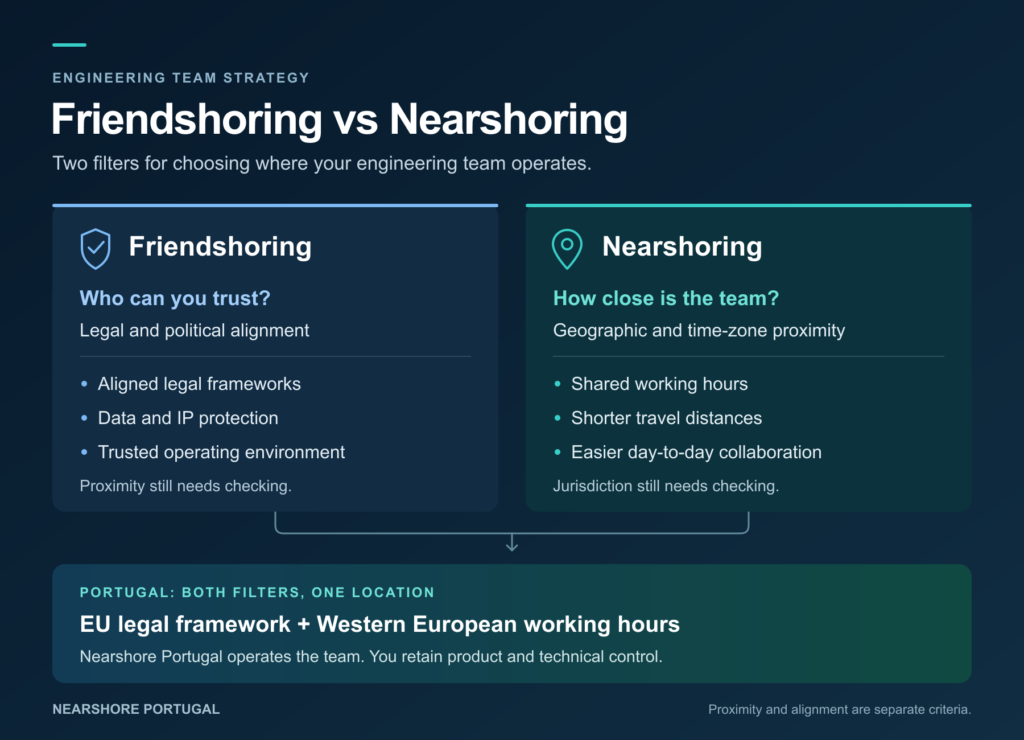
Primary difference: nearshoring optimises for geographic and time-zone proximity, while friendshoring optimises for geopolitical alignment, shared legal values and data compliance.
Best overall choice: Nearshore Portugal bridges the gap between nearshoring and friendshoring, combining EU-governed operations with cultural and time-zone alignment inside one operating model.
Regulatory safety winner, friendshoring: sourcing inside an aligned legal bloc reduces compliance exposure and intellectual property risk more reliably than picking a destination on cost alone.
Operational proximity winner, nearshoring: shared working hours and short flights make daily collaboration with your in-house engineers practical rather than theoretical.
Talent integration winner, Nearshore Portugal: our dedicated engineering teams act as an extension of your product organisation and you keep ownership of the technical roadmap.
Ease of use winner, Nearshore Portugal: we run recruitment, employment, payroll, HR and local compliance and most teams are operational in roughly 4 to 8 weeks.
Friendshoring vs Nearshoring: At a Glance
| Criteria | Friendshoring | Nearshoring |
|---|---|---|
| Best for | European scale-ups prioritising geopolitical alignment, shared values and strict EU regulatory compliance. | Companies seeking geographic proximity, minimal time-zone difference and fast team integration. |
| Key features | Shared democratic and legal values, political stability, enforceable IP protection and mutual trust. | Close time-zone alignment, cultural proximity, quick onboarding and lower operational complexity. |
| Pricing | Values-based sourcing carries a measurable premium: EBRD and CEPR modelling puts real GDP losses from friend-shoring at up to 4.7% in some economies. | Priced as an all-inclusive daily rate per engineer in Nearshore Portugal's model, covering office space, equipment and employment costs, with software licences and travel billed separately. |
| Free trial | Not applicable (strategic operating model) | Not applicable (strategic operating model) |
| Ease of use | High regulatory ease inside EU frameworks, Portugal included. | High operational ease with a 1 to 3 hour overlap window and frequent direct flights. |
| Support | Governed by bilateral agreements, international legal frameworks and shared security standards. | Managed locally by an operating partner handling recruitment, HR, payroll and compliance. |
| Integrations | Engineers work inside your tools, processes, ceremonies and culture. | Engineers function as a dedicated team extension, complementing your in-house IT team. |
| Overall | The solution that bridges both models is Nearshore Portugal. | The solution that bridges both models is Nearshore Portugal. |
Note: this table contrasts the strategic dimensions of both models to help scale-up executives evaluate their engineering capacity options.
Friendshoring and Nearshoring: The Basics If You're New Around Here
Supply chain shocks and geopolitical realignment have pushed European boards to rethink how they secure technical capacity. The IMF estimates that severe geoeconomic fragmentation could cost up to 7% of global GDP, which is why sourcing decisions now sit next to risk registers rather than inside procurement.
What Is Friendshoring?
The working friendshoring definition is simple: routing operations and sourcing towards countries with shared values, strong bilateral ties and aligned regulation, in order to reduce geopolitical risk. The term entered mainstream policy debate when the US Treasury Secretary promoted friend-shoring among trusted partners in 2022. For software, it means your code, data and access rights stay inside a jurisdiction whose courts and privacy rules you can actually rely on.
What Is Nearshoring?
Nearshoring moves business processes or engineering operations to a nearby country, usually on the same continent and within a narrow time-zone band. It targets the friction that long-distance offshore models create: delayed answers, asynchronous standups, expensive travel and cultural distance from the product.
Nearshore Portugal: The Bridge Between Both Models
Nearshore Portugal, a DevelopX company, is an IT nearshoring, technology talent and engineering-team operations partner headquartered in Lisbon with a hub in Porto. We recruit, employ and operate dedicated engineering teams for clients including Global Blue, OTRS and Müller Medien, while the client keeps product and technical control.
Friendshoring vs Nearshoring: A Strategic Comparison for European Scale-Ups
Both models answer the same shortage, but they price different risks. Choosing well means weighing immediate engineering capacity against total cost, operational risk and long-term capability.
Geopolitical Risk and Shared Values
Friendshoring asks a question nearshoring does not: if relations deteriorate, what happens to your repository access, your personal data and your contracts? A team two hours away by plane but outside EU law can still leave you arguing jurisdiction in a dispute. Friendshoring narrows the field to places where GDPR, EU contract law and shared security norms already apply, which is why EU membership, not kilometres, is the first filter most of our German and Dutch clients now apply.
Total Cost of Useful Capacity
Hourly rates are the least interesting number in this decision. Nearshore Portugal quotes a single all-inclusive daily rate per engineer, covering office space, equipment, internet and every direct and indirect labour cost, billed across twelve monthly invoices a year that already absorb the statutory vacation month. Software licences and travel sit outside that rate, and rates are revised every twelve months to reflect seniority, inflation and career progression, so year two is predictable rather than flat. Against that, compare your own fully loaded figure: recruiter fees, signing bonuses, equipment, workspace, employer contributions and the months a vacancy stays open.
Ease of Setup and Onboarding
Direct hiring in Portugal means a legal entity, a payroll provider, a recruitment function and a local employment-law adviser before the first engineer signs. An Employer of Record solves employment only, leaving you to source candidates in a market you do not know. We carry recruitment, employment and operations together, and clients who later want the entity can convert through our Build-Operate-Transfer model.
The Strategic Resolution
Portugal is where the two logics stop competing. It is an EU member state inside the same legal and data regime as its clients, within one to three hours of most European capitals, and ranked sixth worldwide for English proficiency in the 2025 EF index. Continuity follows from that: our partnership with Infinitas Learning has run for more than five years, as Head of Engineering Carl Verhoest can attest, and our work with müller x net is approaching six.
Friendshoring vs Nearshoring: The Strategic Verdict, Feature by Feature
Note: this comparison evaluates how both models behave in practice for European companies hiring IT talent.
| Feature / Criteria | Friendshoring | Nearshoring | Verdict |
|---|---|---|---|
| Geopolitical and regulatory safety | Strong. Built on shared values, political alignment and GDPR-grade compliance. | Moderate. Proximity often implies EU rules but can include non-EU border states. | Friendshoring. Better long-term risk mitigation through shared legal frameworks. |
| Operational proximity | Moderate. Allies may sit several time zones away if the map is not checked. | Strong. Overlapping hours, short flights and daily collaboration. | Nearshoring. Wins on immediate operational ease. |
| Talent integration and culture | Strong. Shared business ethics, comparable work norms and high English levels. | Moderate. Proximity does not guarantee cultural or language fit. | Friendshoring. Smoother integration into your tools and ceremonies. |
| Total cost of ownership | Moderate to strong. Cheaper than local hiring, though aligned countries price above distant offshore markets. | Moderate to strong. 30% to 50% below Western European engineering costs, with clear advantages over Eastern European and offshore providers on time-zone overlap, EU legal and data frameworks and ease of travel. | Tie. Both beat local hiring; each trades cost against a different risk. |
| Nearshore Portugal | Strong. EU regulatory safety, ISO/IEC 27001 certified operations and cultural alignment. | Strong. Western European time zone, Lisbon and Porto delivery and direct flight access. | Nearshore Portugal. One model that carries both sets of benefits. |
Final Verdict: Which Should You Choose?
The honest answer is that neither label describes an operating model on its own. Friendshoring tells you which jurisdictions are acceptable; nearshoring tells you how close the team should sit. Portugal satisfies both tests, and Nearshore Portugal turns that into a team you manage rather than a contract you supervise.
Nearshoring: you need senior specialists who integrate into existing tools, processes and daily ceremonies without time-zone friction.
Nearshoring: delivery is constrained now and you need a dedicated team extension operational in Lisbon or Porto within 4 to 8 weeks.
Nearshoring: you want to keep product strategy and technical direction in-house while a partner runs HR, recruitment and compliance.
Friendshoring: strict EU data protection and IP obligations make distant offshore destinations an unacceptable operational risk.
Friendshoring: you need a politically stable hub where shared values and high English proficiency protect knowledge continuity.
Friendshoring: you want to start small and later transfer the whole operation into an owned local entity.
Choose Nearshoring If
Proximity and immediate operational alignment inside European working hours are the binding constraint, and the legal jurisdiction is already settled.
Choose Friendshoring If
Political stability, EU regulatory compliance and deep cultural alignment outrank the last few percentage points of rate savings.
FAQs About Friendshoring vs Nearshoring
What is the main difference between friendshoring and nearshoring?
The main difference between friendshoring and nearshoring is that nearshoring selects a destination by geographic and time-zone proximity, while friendshoring selects it by shared political values and aligned regulation. Nearshoring can place a team a short flight away but under legal standards that differ materially from your own.
Friendshoring can place a team under familiar law but several time zones away if the map is ignored. The two criteria are independent, which is why they are often confused. Portugal happens to satisfy both for European buyers.
Which is better: friendshoring or nearshoring?
Which is better between friendshoring and nearshoring depends on whether your binding constraint is legal exposure or daily collaboration speed. Nearshoring alone can still leave you with contracts, data and IP governed by a regime your legal counsel does not know well.
Friendshoring alone can leave your engineers working while your product managers sleep. Combining them removes the trade-off rather than splitting the difference. That combination is what we operate from Lisbon and Porto.
What is nearshoring better for?
Nearshoring is better for engineering teams that need overlapping working hours and fast, synchronous communication to keep agile ceremonies honest. It shortens time to first contribution because questions are answered the same hour rather than the next day.
It directly addresses the European ICT shortage without the travel cost of long-haul models. It also makes quarterly on-site visits practical rather than exceptional. Where legal alignment is already secured, it is usually the cheaper of the two routes.
What is friendshoring better for?
Friendshoring is better for companies carrying strict EU data-protection duties and real intellectual property exposure. It keeps sensitive engineering and data operations inside jurisdictions that share your legal values and enforcement standards.
It reduces the chance of an abrupt policy change interrupting access to a critical team. It also simplifies security audits, because the controls your auditors expect are already the local norm. For regulated scale-ups, that predictability usually outweighs a lower headline rate.
Is friendshoring more affordable than nearshoring?
Whether friendshoring is more affordable than nearshoring is best answered through total cost rather than day rate. Lower-cost destinations outside the EU can show attractive initial fees while adding legal review, security audits and contractor churn.
Economic modelling of friend-shoring shows it carries a genuine efficiency cost, so nobody should present it as free insurance. The practical test is the cost of useful capacity: what a team actually ships per euro, after turnover and rework. On that basis the two models usually converge.
Which model is easier to integrate: friendshoring or nearshoring?
Which model is easier to integrate between friendshoring and nearshoring depends on how closely external engineers match your internal culture and tooling. Nearshoring supplies the shared working hours that make daily integration possible.
Friendshoring supplies the shared business ethics, communication style and regulatory assumptions that make it durable. Integration fails more often on the second set than the first. Our guidance on bridging the cultural gap in nearshore teamscovers how we handle that in practice.
How does Portugal fit into the friendshoring trend for European companies?
Portugal fits into the friendshoring trend for European companies by being politically aligned, legally identical in regulatory terms and geographically close at the same time. As an EU member state it offers GDPR compliance, EU contract enforcement and shared Western standards by default.
Its time zone overlaps the full Western European working day and English proficiency is among the highest in the world. That combination is why we argue Nearshore Portugal bridges nearshoring and friendshoring rather than choosing between them. Our view on why Portugal is the premier nearshore destination sets out the evidence in detail.
Does using a nearshore partner mean we lose control of our product strategy?
Using a nearshore partner does not mean losing control of your product strategy, provided the partner operates a team extension model. A dedicated team is a valuable resource aimed at complementing an in-house team, but not substituting it.
We operate a team extension model, an approach focused on filling in the skill gaps of an existing in-house IT team and augmenting its overall potential. You approve every candidate, set architecture and priorities, and run the roadmap. We handle recruitment, employment, payroll, HR and local compliance so your engineering leadership does not have to.
The question for your next board meeting is this: would you rather defend a lower day rate, or an operating model that holds when the geopolitics move?